Reading Guide: Spacewalking with You, Volume 1
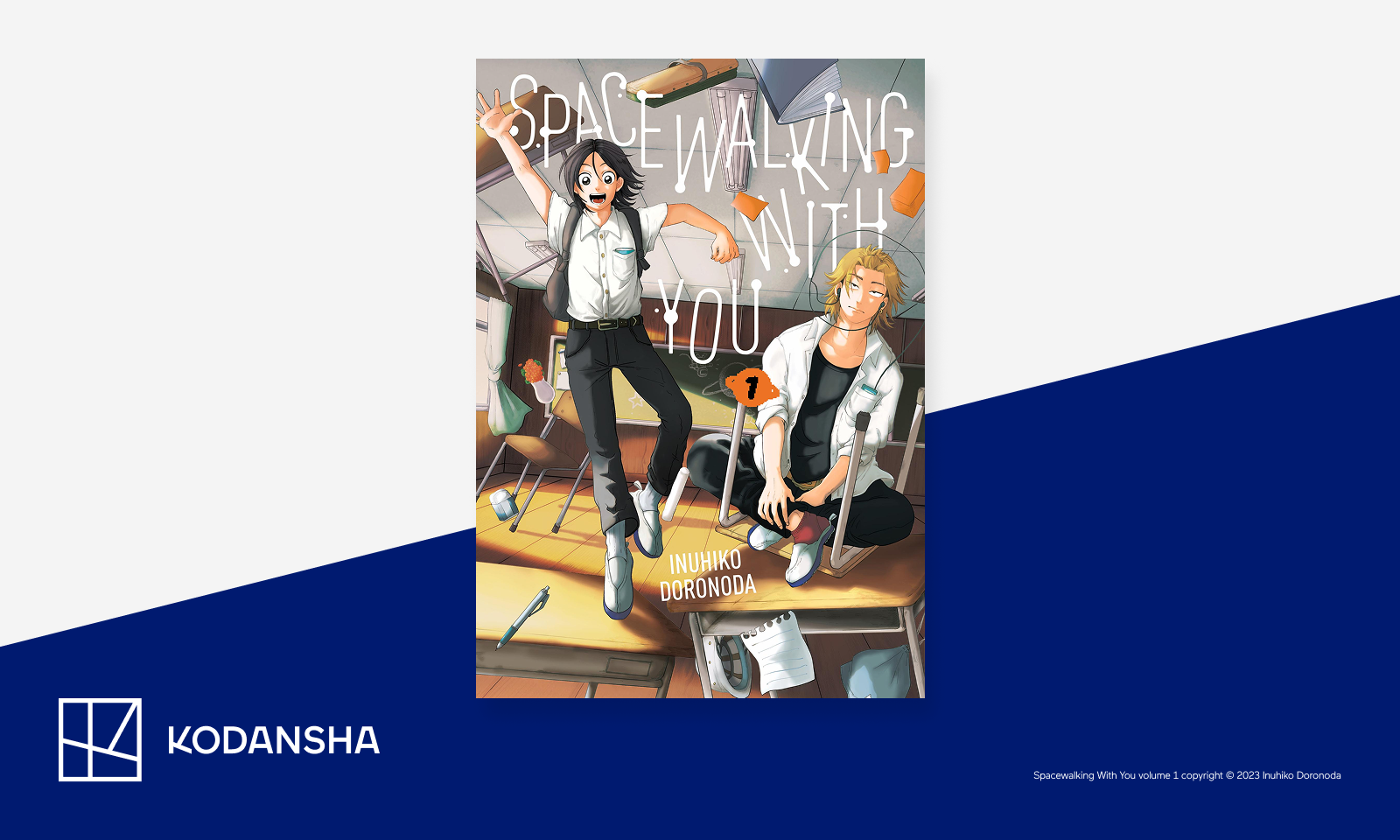
Spacewalking With You, Volume 1
Manga by Inuhiko Doronoda
Reading Guide created by Matt Slayer
Beta Version
In this guide:
- How to Read Manga
- Overview
- Key Themes
- Setting
- Key Characters
- Discussion Questions
- Activities
- Pairing Suggestions and Read-a-Likes
How to Read Manga
Inuhiko Donoda’s heartfelt coming-of-age story Spacewalking With You has been kept in the original Japanese comic orientation, where the stories are read from right to left. This means that actions are followed right-to-left, word balloons and sound effects are read right-to-left, and the overall flow of the images on the page are read starting in the upper-right corner of the page and then flows from right to left to the bottom left corner of the page. This helps preserve the integrity of the original artwork and storytelling choices. It sounds more complicated than it is!
Overview
Keisuke Uno, the new transfer student, seems a little… odd. He speaks enthusiastically and can come off as being intense. He’s often heard talking to himself, and he carries a worn notebook with him everywhere he goes, constantly referencing its scribbled contents. Loud noises seem to physically pain him, and he’ll curl up into a ball at a moment’s notice. But to Yamato Kobayashi, as different as Uno is, there’s also something undeniably cool about him. He does his own thing and lives by his own set of rules, seemingly unconcerned with what others think about him—exactly how Kobayashi wishes he was. As the two become friends and Kobayashi learns how hard Uno works to keep himself grounded, can he be inspired by Uno to walk his own path?
Spacewalking With You Volume 1—named top shonen series of the year in the Kono Manga Ga Sugoi (“This Manga is Cool!”) Japanese industry poll and winner of the 17th Manga Taisho Grand Prize—is a genuine, heartfelt, and enlightening look into the lives of two boys who, on the surface, couldn’t seem more different from one another. Kobayashi is a “delinquent” who struggles at school and work, and Uno is… well… Uno. Although the book never explicitly states that Uno is neurodivergent (a deliberate choice by the author), his behaviors are consistent with many people on the autism spectrum, and his differences are a central theme of the book. Uno’s and Kobayashi’s experiences illustrate for readers how some people “just need a little something extra so they can live like everyone else.”
Volume 1 follows the two boys as they navigate school and work, and as Kobayashi learns strategies from Uno for how to better himself. As they become friends, Kobayashi convinces Uno to join the school’s Astronomy Club where Uno can freely talk about his favorite subject—outer space and everything within the cosmos—without fear of judgement. All throughout, both boys try to find their place in the world while dealing with interpersonal issues between each other, friends, coworkers, and even the Astronomy Club’s gloomy president.
Funny yet earnest, Spacewalking With You allows readers to build their empathy and emotional intelligences as they witness Kobayashi overcome his apathy and care for his new friend. Beyond opportunities to learn more about neurodivergent people and their perspectives, the book also encourages readers to be kind to themselves and others when they struggle or are overwhelmed with emotion. The book’s characters often find themselves in frustratingly relatable situations, such as not being able to accurately express thoughts or needing to pluck up the courage to ask for help. But the story’s creator, Inuhiko Doronoda, depicts these common human dilemmas in ways that allow readers to laugh at the characters and at themselves. Character’s inner thoughts and depictions of their private lives help remind readers of the rich and complex realities that we all navigate, even if much of it goes unseen by others.
Spacewalking With You Volume 1 is an endearing beginning to this brand-new series. Teens and adults will love following Kobayashi’s and Uno’s friendship, all while the series is bound to gain traction amongst teachers, librarians, mental/behavioral health professionals, and groups that advocate for and support people with autism and their loved ones. Prepare for takeoff, and discover new perspectives on your spacewalk with Uno!
Note about language used in this guide: The Americans with Disabilities Act Language Guide suggests that people “in general, refer to the person first and the disability second.” However, it also acknowledges that “people with disabilities have different preferences when referring to their disability. Some people see their disability as an essential part of who they are and prefer to be identified with their disability first—this is called Identity-First Language. Others prefer Person-First Language. Examples of Identity-First Language include identifying someone as a deaf person instead of a person who is deaf, or an autistic person instead of a person with autism.” This guide uses both identify-first (autistic person) and person-first (person with autism) language. As leaders use this guide to facilitate discussions around this book, remember to be mindful of language used and encourage readers to be mindful as well. When referring to a specific person, it is always important to listen to how they refer to themselves or ask their preference.
Key Themes
Neurodiversity – Although the book does not explicitly discuss specific conditions or clinical diagnoses under the umbrella of neurodiversity, many readers may recognize Uno as having traits and behaviors that are most associated with people on the autism spectrum. He can sometimes struggle with overstimulation and social cues, but he is also incredibly earnest and bright with an intense love for all things related to outer space.
The story takes place during a time when people were less knowledgeable about neurodivergent people and their various unique needs. Because of this, some characters are confused by Uno and are unsure of how to act with or around him. As Kobayashi learns more about Uno and some of his accommodations (such as his notebook full of tips and rules for everything from social interactions to riding the bus), he realizes that some of Uno’s strategies for navigating the world can be helpful to him as well. Spacewalking With You can be an incredible tool for building empathy for those with neurodivergence. Through its earnest glimpse into the life of Uno and his loved ones, the story can help many people feel seen and understood.
Inner Lives vs. Outward Appearance, Empathy – One of the strengths of comics and manga is the ability to read characters’ thoughts, especially when they are at odds with the words they are saying or their facial expressions and body language. In Spacewalking With You, many of the characters’ internal lives and monologues are juxtaposed with the appearances they try to keep. Although Kobayashi tries to appear cool and uncaring on the surface, he is actually riddled with self-doubt. He may seem quick to anger, but this comes from deep insecurities and fear of embarrassment. In addition, he struggles at work (page 55) and is treated poorly at home—something that his teachers and classmates may never see. Mikawa, a quiet third-year student, seems judgmental of others, but he secretly deals with depression and self-loathing. Even Uno, who appears nothing but genuine, must hide any sadness he feels until he gets home. He masks many of his true emotions and desires to more-easily survive his day-to-day.
Eventually, Mikawa and Kobayashi realize that just as the planets in the sky are “more than just dots,” the people around them are more complex than they appear on the surface. For the reader, these looks into characters’ thoughts and circumstances can help build empathy and sonder.
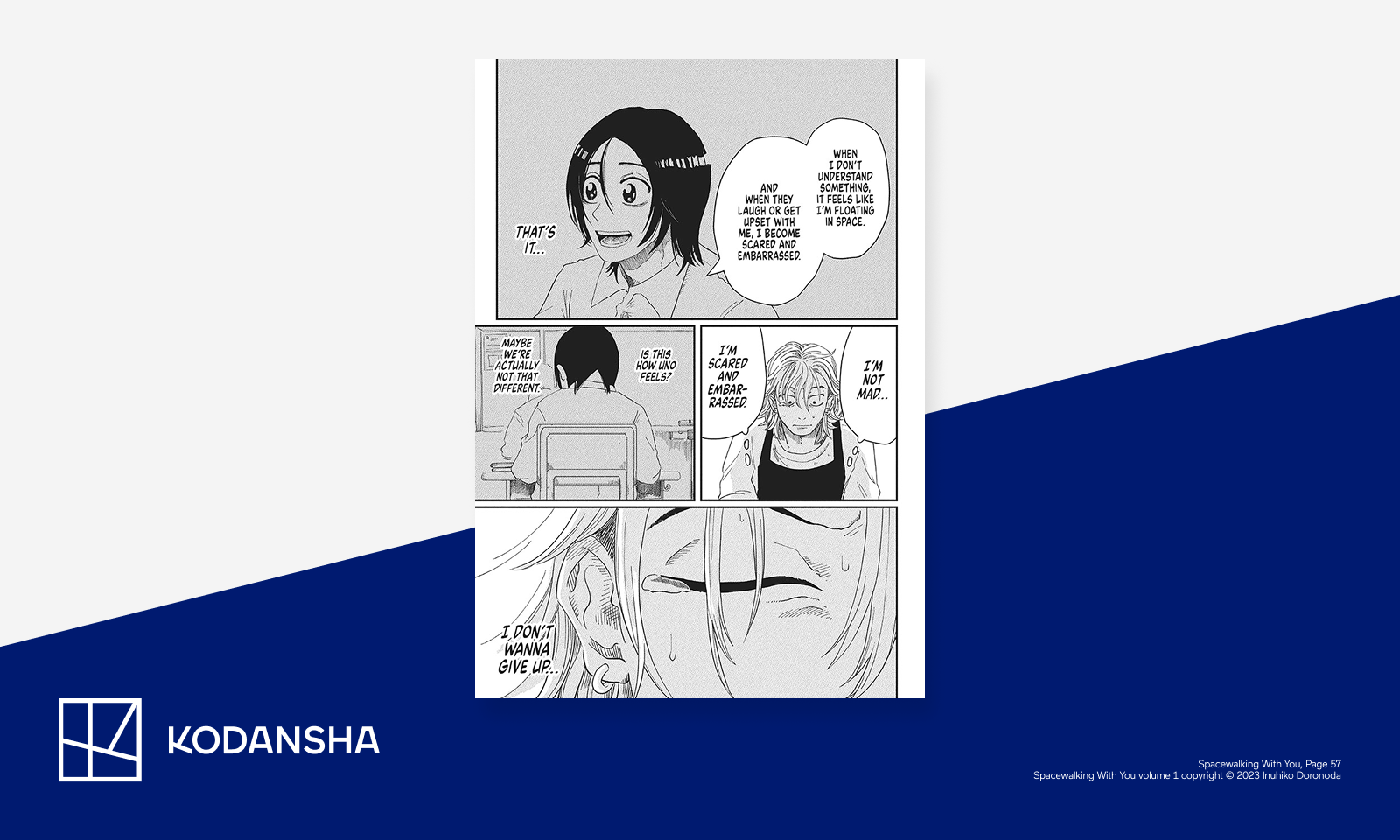
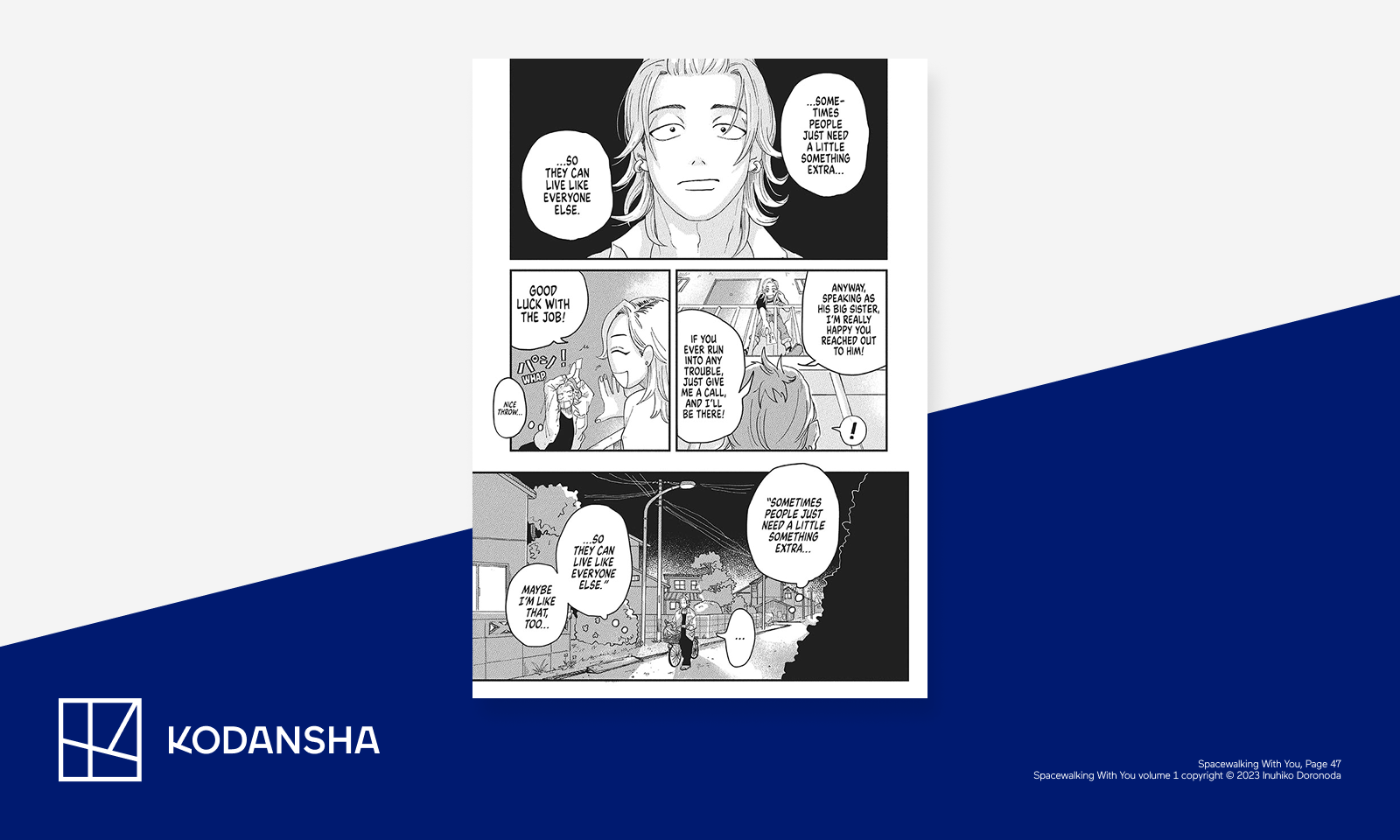
Accommodations and Scaffolds – Kobayashi isn’t a quick learner, and because of this (along with negative reinforcement at home), he has always struggled with school and work tasks. When he meets Uno, however, he learns about all the scaffolds that Uno has built to help him meet the expectations of others. Kobayashi learns that, as Uno’s sister puts it, “sometimes people just need a little something extra so they can live like everyone else.” For Uno, this means taking diligent notes, removing himself from overstimulating situations, and always having his notebook—a survival manual for everyday life—that keeps him from feeling lost and afraid. Kobayashi learns that he too can benefit from modifications of these techniques; asking for multiple explanations of how to do something, taking notes, and most of all, being kind and patient with himself when he makes mistakes or isn’t on par with others (page 57).
Readers will understand how accommodations can benefit different people, and they will have a better understanding of how to accommodate others. In addition, readers will learn how some accommodations that are meant to benefit specific populations can help others too.
Individuality – Kobayashi desperately wants to appear independent and cool, uncaring of what others think. He does this by wearing a mask of indifference, primarily as a defense mechanism from judgement or embarrassment. Uno, on the other hand, is effortlessly unique and “does his own thing,” partly out of necessity. When Kobayashi begins to take cues from Uno in order to help himself in school and at work, it causes tension with those around him. Being a true individual, free from the pressure and expectations of other people, is hard work. Although Uno may struggle more than most with many social situations, he excels at individuality, which neurotypical people can sometimes find challenging.
Friendship – Uno is used to masking himself around others and making himself palatable according to their comfort levels. He does not have friends, and he isn’t used to the feeling of ease that a friend’s presence can provide. Because of this, he is hesitant to call Kobayashi a friend. Kobayashi, who has had his close friend Saku since childhood, empathizes with Uno’s isolation. He works hard to be a true friend to Uno. Eventually, this causes issues with Saku, who feels like he no longer knows his best friend and has been abandoned by him. Each friendship takes different forms of work and communication to keep them strong. In turn, each individual is better off because of the work they put in.
Belonging – At the beginning of the book, Kobayashi seems content to not have a place in the world. He struggles to hold down a job, has few friends, and doesn’t seem to have any ambitions or goals. Even as he realizes the source of his apathy—fear of embarrassment and rejection—he still struggles to find a place that he belongs. He dropped out of the Soccer Club, has an uncomfortable home life, and he is made to feel like he doesn’t belong at the Astronomy Club. Similarly, Uno has spent much of his life alone, preferring the relative ease of solitude over the challenges of socialization or the rejection of others. Throughout the book, Kobayashi and Uno realize that they can support one another and find comfort in each other as they try to find their places in the broader world.
Setting
According to the book’s creator Inuhiko Doronoda, Spacewalking With You takes place during an unspecified part of the Heisei Era (1989 – 2019). Modern ubiquities such as social media and smart phones are nowhere to be seen, although Kobayashi is at one point shown talking on a flip phone. This points to the book possibly taking place sometime in the early 2000s. The period is important when considering how research and awareness around neurodiversity has changed over the years. While Uno’s behaviors might suggest to modern readers that he is on the autism spectrum, research and awareness around neurodivergence was less prevalent during that time. In the book’s afterward, Doronoda asks, “What things did we know, and what things were we unaware of? I try to ask myself those questions as I write this story.”
Locations for the book’s events include Uno and Kobayashi’s homes and school, and at Kobayashi’s job; a second-hand media and hobby store called “Second House.”
Key Characters
Yamato Kobayashi – Described as a “yanki” or “delinquent,” Kobayashi tries to play it cool in most parts of his life. On the surface, he seems like the average burnout who can’t be bothered to apply himself at school and is unconcerned with his performance at work. But on the inside, Kobayashi is complex and naturally empathetic. His new friendship with Uno allows him to see himself in a new light and grow in self-esteem and emotional maturity.
Saku – Saku has been best friends with Kobayashi since childhood. He is more carefree than Kobayashi, and he loves to joke and play pranks—often at the expense of others. Saku has a tough exterior, but he has a good heart and is loyal to his friends.
Keisuke Uno – Uno is a new transfer student at Kobayashi’s school. Uno has many behaviors that set him apart from other students; he speaks loudly and enthusiastically, frequently talks to himself, is always smiling, and can be easily overwhelmed by crowds and loud noises. He always carries a notebook that contains rules and tips to help him navigate day-to-day life. Uno is very adherent to the contents of his notebook, and he feels lost without it. Uno’s favorite subject is space, and although he mostly indulges alone, he will take any opportunity to talk with others about it.
Second House Employees – Kobayashi has a part-time job at Second House, a store that buys and sells media, figurines, trading cards, and other miscellaneous items. He has two coworkers who take different approaches to working with him. One is extremely critical, while the other tries to be more forgiving. Kobayahsi’s manager models patience when working and speaking with him, and he is quick to make accommodations according to his needs.
Uno’s Sister – Uno lives with an older sister whom Kobayashi runs into a few times in the book, both at Uno’s home and at Second House. She understands Uno better than anyone else, and although she gives him autonomy, she also helps advocate for Uno and the accommodations he needs.
Inoue-sensei – “Sensei” is the Japanese honorific used for teachers or other experts. Inoue-sensi is a science teacher at Kobayashi and Uno’s school, and he is the sponsor of the Astronomy Club. He is an older teacher with only one year before retirement, and he shows great patience and wisdom with his students.
Subaru Mikawa – Mikawa is a 3rd-year student and the only member (and therefore president) of the Astronomy Club. He considers himself to be “gloomy” and “borderline creepy,” preferring to keep to himself at school. Like the story’s other characters, Mikawa has an inner life that most others seem to be unaware of. He deals with poor self-esteem and other issues that could be indicative of anxiety and/or depression. He considers himself bad at conversation, and although he starts on the wrong foot with the club’s new members, Uno is eager to discuss their shared love of the cosmos.
Discussion Questions
- On page 47, Uno’s sister says, “sometimes people just need a little something extra so they can live like everyone else.” What are some examples of “something extra” for Uno and Kobayashi in the book? What are some examples of this you can think of in real life? Do you think it is common or uncommon for people to need “a little something extra?”
- In what ways is Kobayashi the archetypical “delinquent?” In what ways does he defy conventions and expectations?
- When Kobayashi begins to apply strategies to help him in school and at work, how do the people around him react? What did Kobayashi learn from Uno that he applied at his job? What can you learn from each of the characters that work at the store?
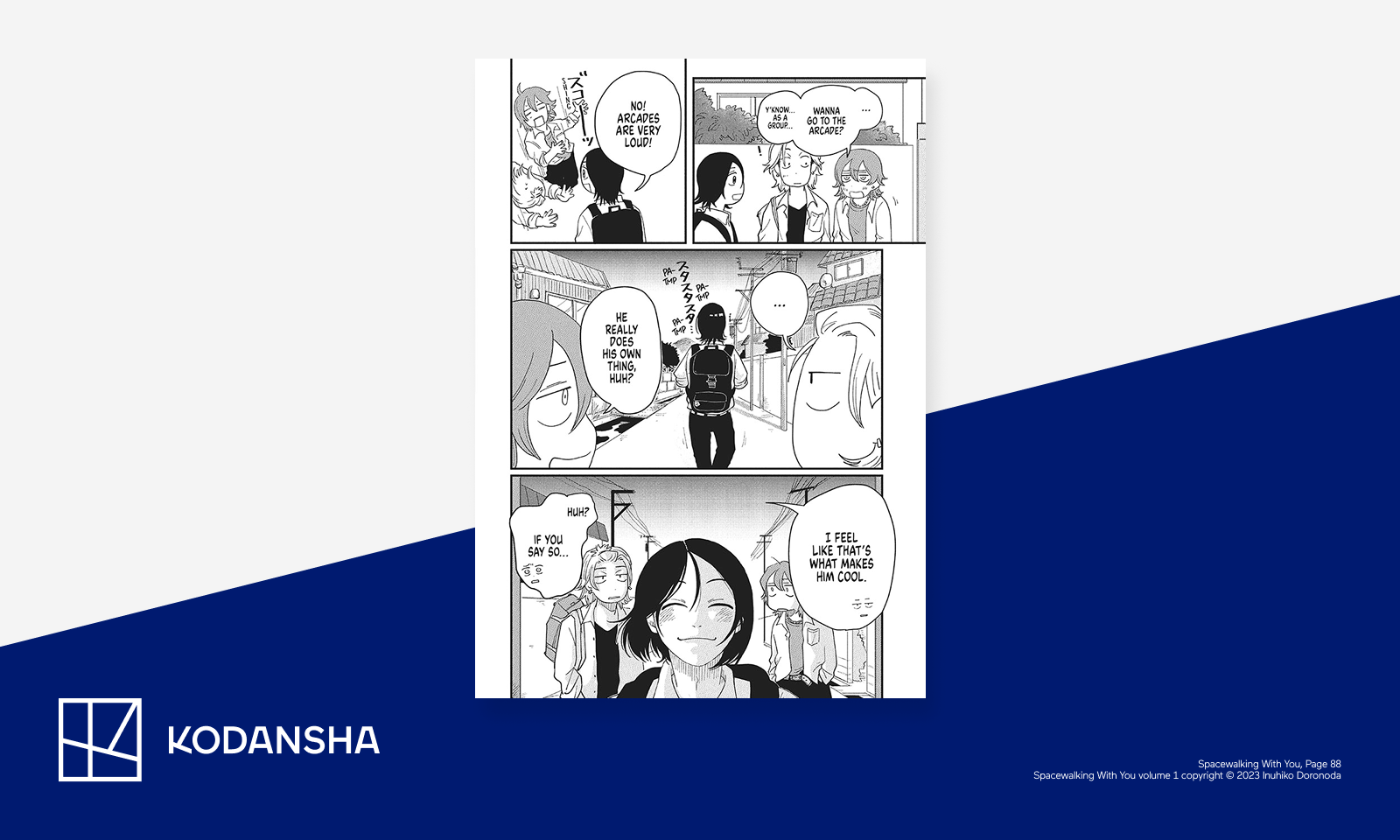
- On pg. 88, Uno energetically denies an invitation to go to the arcade. Saku says, “He really does his own thing, huh?” to which Kobayashi replies, “I feel like that’s what makes him cool.” Why do you think Kobayashi admires this quality about Uno?
- After learning about Venus from Uno, what does Venus come to represent for Kobayashi?
- Why do you think Mikawa is antagonistic to Kobayashi when they first meet? What do you think motivates Mikawa to give Uno the advice he gives on pages 184-188?
- How would you describe Kobayashi? What are some of his positive character traits? What character traits hold him back from success?
- How are Kobayashi and Uno similar to one another?
- Kobayashi realizes that his anger is often caused by feelings of fear and embarrassment. Have you ever felt one emotion, then later realized there was more beneath the surface? What caused Kobayashi to have this reflection and realization?
- How do you think Uno came up with each tip or rule in his notebook?
- Sometimes, Kobayashi has trouble expressing his inner feelings with words. Where do you see evidence of this throughout the book? In these moments, how do the images give insight to what Kobayashi is really feeling? How does Kobayashi handle these moments throughout the book? How does he find ways to express himself?
- How do different characters’ facial expressions give insight to how they’re feeling throughout the book? Cite specific panels to support your answer.
- What does the book have to teach us about people’s inner lives vs. their outward appearances? How do Uno, Kobayashi, Mikawa, and other characters represent this?
- There are many areas in life where Uno has to work harder than others. But there are also many areas where Uno excels, and he is unbothered by things that might bring others down. In what areas does Uno excel or have an advantage over others?
- What are some of the themes of Spacewalking With You Volume 1? How does the conversation between Mikawa and Inoue-sensei on pages 201-204, as well as the following pages, summarize the themes of the book?
Activities
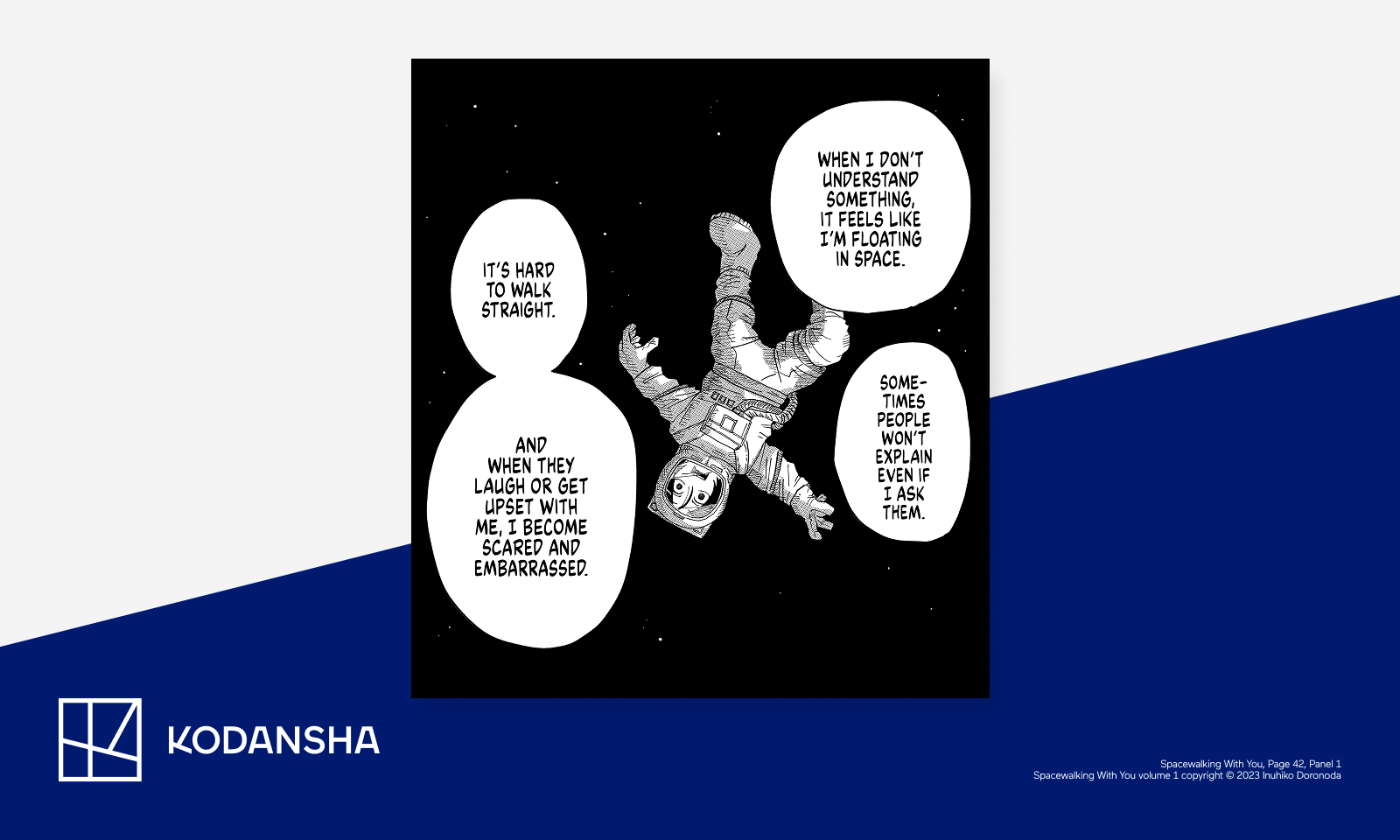
Find Your Tether – In Spacewalking With You, Uno calls his notebook his “tether.” He likens it to the tethers that astronauts use on spacewalks to ensure they don’t float away from their spacecraft or space station. Similarly, Uno’s notebook full of tips and rules keeps him grounded and free from the feeling of floating alone in space. In this project, readers can identify or create their own “tether”—something that helps ground them in times of fear, frustration, or confusion.
First, ask readers to identify times that they feel like Uno floating alone in space. If that analogy doesn’t resonate with them, you may ask them about times that they feel overwhelmed. Then, ask them to write down what triggers that feeling and what specific emotions they feel in that moment. Finally, ask if there is an item or practice that comforts them or could potentially relieve the negative feelings. The item or practice would be their “tether”. For example, when Uno doesn’t know what to do or he feels overstimulated, he is feeling confused and fearful. Having a set of “rules” or reminders guides him to comfort. For some readers, their tether could look similar, like a set of rules, reminders, or affirmations. For others, their tether might be a symbol, a stuffed animal, a token, or a breathing ritual that can help ground them. Encourage readers to create their tethers as necessary (which can be a great use of library maker spaces) and to use them when they need help navigating challenging situations.
Character Growth – Throughout the book, Kobayashi experiences significant personal growth. In this activity, encourage readers to find specific moments in the book where Kobayashi experiences this growth. Using a table, readers can document details about each moment including the page number of the event, how Kobayashi changed or grew in that moment, and what caused him to change. If desired, readers can also document moments of growth for other characters in the story.
After readers analyze the book, facilitate a group discussion using the following prompts:
- How did Kobayashi grow throughout the book? What caused his growth?
- How did other characters grow throughout the book? What caused their growth?
- Do you think these fictional characters change and grow in ways that are similar to real people? Why or why not?
- Can we make any generalizations about how people change and grow and what causes them to do so based on the book?
- Do individuals need different catalysts to help facilitate change and growth? Why do you think that?
- Does change come from within or from outside pressure? Why do you think that?
- Do you think Kobayashi will continue to change throughout the series? If so, how? Why do you think that?
Neurodivergence Awareness and Research – Today, society is far more aware of various neurodivergences including autism spectrum disorder, ADHD, dyslexia, obsessive-compulsive disorder, etc., than it was decades ago. However, people are not always equipped with factual information, or they may not have a practical understanding of what it means to be neurodivergent or to love people whose brains work differently. For this activity, readers will first reflect on what they do and do not understand about neurodivergence. Then, they will conduct research about one of the various conditions and/or disorders within the neurodivergence umbrella, including the experiences of people with that condition and/or disorder, and how to best support them.
First, the group’s facilitator should ensure that everyone has a consistent and accurate understanding of neurodiversity using this article from Cambridge University Hospitals or this article from Cleveland Clinic. Then, individually or as a group, readers can choose one of the listed conditions or disorders and fill out a KWL (Know, Want to Know, Learned) chart, beginning with what they know or want to learn about the chosen condition or disorder and how people experience it. Next, ask readers to conduct research to learn more about the experiences of people with their chosen condition or disorder. Challenge readers to find at least two informational sources in different mediums (such as books, websites, videos, podcasts, etc.), and facilitate a discussion where they or the group’s facilitator can add new information to the chart (and potentially correct misleading or incomplete information previously added). It is strongly recommended that you reach out to local non-profits, schools, or other organizations that work with neurodivergent people to see if they or a member of their community would be willing to speak to your students and/or help lead this activity. Personal accounts and face-to-face interactions are the most effective and authentic ways of building knowledge and empathy.
Your User Manual – In Spacewalking With You, Uno has created a “user-manual” of sorts to help him navigate life. Now, imagine if Uno had made a version of this “user-manual” for others with the purpose of teaching them about himself and how to best support him. Everyone, both on and off the autism spectrum, has individual quirks that others may not understand about us and that can be challenging to navigate. In this project, readers will create their own user-manuals that can be given to teachers, friends, or others, to help them understand their inner workings and quirks.
First, instruct readers to brainstorm a list of things that they think others should know about them. Readers can start by thinking about the following:
- What are some of their likes and dislikes?
- What makes them angry or frustrated?
- What makes them feel appreciated? What is the best way to bring up an uncomfortable topic with them?
- What types of communication styles or love languages do they prefer?
Next, readers should sketch a layout for their manual. When sketching their layouts, readers can ask themselves the following questions:
- Will there be pictures, illustrations, or infographics in the manual?
- How will the manual’s aesthetics match your own?
- How will the information be organized to best suit the reader?
- What will be on the cover?
Finally, readers should create their manuals. They may wish to do this by customizing and writing in purchased notebooks, making their own manuals using construction paper, string, etc., or even creating their manual digitally. After readers have created their manuals, encourage them to share with one another. This will allow them an opportunity to practice sharing their manuals with others in the future.
Pairing Suggestions
- Komi Can’t Communicate by Tomohito Oda. VIZ Media (Manga/Anime Series)
- Frieren: Beyond Journey’s End by Kanehito Yamada and Tsukasa Abe. VIZ Media (Manga/Anime Series)
- My Brother’s Husband by Gengoroh Tagame. Pantheon. (Manga Series)
- Button Pusher by Tyler Page. First Second, 2022. (Graphic Novel)
- Weirdo by Tony Weaver. First Second, 2024. (Graphic Novel)
- The Curious Incident of the Dog in the Night-Time by Mark Haddon. Doubleday, 2003. (Novel/Play)
- Atypical created by Robia Rashid. Netflix. (Television Series)
- Temple Grandin: An Open Door directed by John Barnhardt. 2024. (Documentary)
- Temple Grandin directed by Mick Jackson. HBO, 2010. (Film)
- To the Moon developed by Freebird Games. Freebird Games, 2011. (Video Game)
Spacewalking With You volume 1 copyright ©2023 Inuhiko Doronoda
English translation copyright ©2025 Inuhiko Doronoda
Spacewalking With You Reading Guide ©2025 Kodansha
All rights reserved