Reading Guide: Witch Hat Atelier, Volume 1
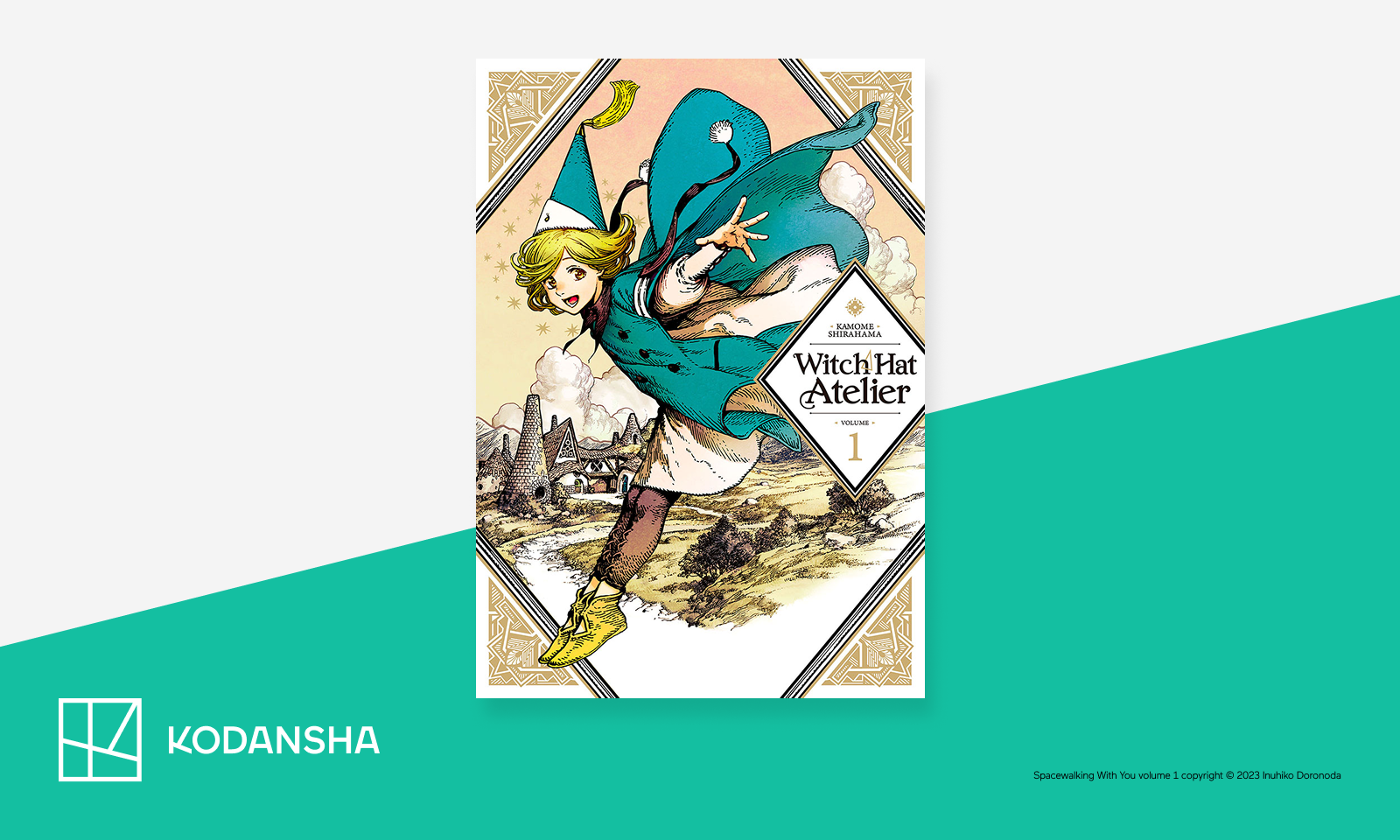
Witch Hat Atelier, Volume 1 Reading Guide
Manga by Kamome Shirahama
Reading Guide created by Matt Slayter
Beta Version
In this guide:
- How to Read Manga
- Overview
- Key Themes
- Key Characters
- Discussion Questions
- Activities
- Pairing Suggestions and Read-a-Likes
How to Read Manga
Kamome Shirahama’s rich fantasy coming-of-age story Witch Hat Atelier has been kept in the original Japanese comic orientation, where the stories are read from right to left. This means that actions are followed right-to-left, word balloons and sound effects are read right-to-left, and the overall flow of the images on the page are read starting in the upper-right corner of the page and then flows from right to left to the bottom left corner of the page (see image below). This helps preserve the integrity of the original artwork and storytelling choices. It sounds more complicated than it is!
Overview
Coco’s spell has gone incredibly wrong.
For years, young Coco has obsessed over magic, “the miracle that makes our world vibrant,” but has lamented the fact that she wasn’t born a witch. Now that she has finally met a real witch and seen how spells are performed, she knows their secret; magic is drawn, and casting it requires no more than creating lines and shapes with magical ink! As Coco attempts her first spells, however, she accidentally turns her mother and her home to stone. Her deed has not gone unnoticed, and she has been whisked away to study magic and to discover how to undo the damage.
On the surface, Witch Hat Atelier may seem familiar to fans of manga and fantasy; Coco discovers a hidden magical world and trains under a mentor to be a spellcaster alongside other girls her age, she is seemingly caught in the middle of a budding battle between good and evil, and like many other early entries in manga sagas, Coco must overcome a trial to prove her worth. Woven into the fibers of this story’s pages, however, is a reverence for art and its creators. Coco’s adoration of magic and her journey to become a witch is a reflection of the artistic process in the real world and the trials of mastering a skill that, to outsiders, may seem like magic. In addition to these added layers, Kamome Shirahama—an acclaimed cover artist for DC and Marvel—brings life to her story through a mixture of art styles reminiscent of fantasy classics and art nouveau but splashed with the kind of visual humor that manga fans will instantly recognize. This layering of familiar tropes, fresh perspectives, endearing characters, and captivating artwork has led the series to sell millions of copies worldwide, and made Witch Hat Atelier one of the newest major manga and anime IP.
Reading Witch Hat Atelier is not unlike tasting a new take on a favorite comfort food. Readers will be embraced by the cozy setting and familiar subject matter yet surprised by the story’s poignant messages. After Coco comes to the realization that being a witch is not determined by birth but by learned skill, circumstances push her to leave her home and pursue a life dedicated to the art of witchcraft. Similarly, there are professions in the real world—particularly in the arts—that are thought of as being meant for only the gifted few. However, in reality, obtaining these goals is not a matter of destiny, but a matter of will and dedication. Many readers will see themselves in Coco or be inspired by her as she, despite her mother’s wishes, leaves home to immerse herself in her passions. Anyone who has chased after the mastery of creative or technical skills will know the feeling of unease that comes along with taking first steps, or the pressures of being compared to others in their field. In Witch Hat Atelier, Coco models what it means to be tenacious, determined, and fearless in these situations, but not without inevitable mistakes and shortcomings. Readers that have experienced this process of training, trials, and mentorship, as well as those who need inspiration to begin their own journeys, will be drawn into Coco’s story.
Witch Hat Atelier has been critically acclaimed with honors including an Eisner Award for Best U.S. Edition of International Material and a Harvey Award for Best Manga, and it was included in the American Library Association’s “Top 10 Graphic Novels for Teens” list in 2020. Now, as the series continues with new chapters, and supported by its hit anime adaptation, there has never been a better time to don the witch’s cap and experience Coco’s adventures!
Key Themes
The Magic of Art – In the world of Witch Hat Atelier, magic is cast with strokes of a pen. Shapes drawn with precision and intention summon the powers of fire, water, levitation, and object manipulation—if they are drawn with magical ink, of course.
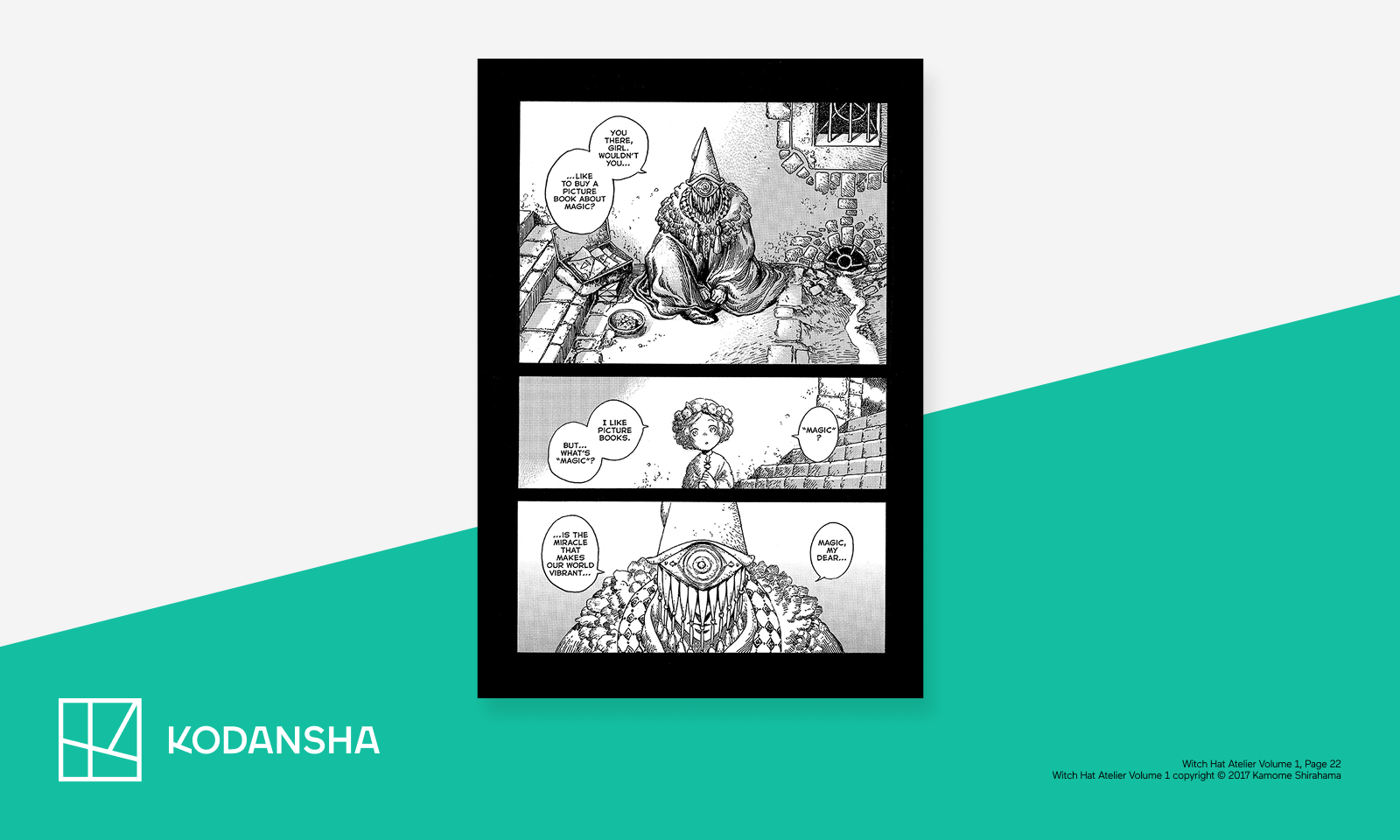
According to the book’s creator, Kamome Shirahama, “The story was sparked by a casual comment from a friend, who mentioned that the process of bringing an illustration into the world seemed just like magic” (pg. 22). As such, many comparisons can be drawn between the depictions of magic in the world of Witch Hat Atelier and the power of art in the real world. Early in the book, magic is described as “the miracle that makes our world vibrant.” Yet only certain people are given the power and authority to add that vibrancy to the world, with the general population believing that you must be born a witch to wield magic. This mirrors many people’s belief that artists are born with inherent talent, and that only those born with the gift may be chosen to bless the world with their art. Just as many parents are wary of their children’s desire to study art, Coco’s mother is wary of her daughter’s obsession over magic. In the real world, art can celebrate joy or empathy, or it can propagandize hate or division; similarly, in Witch Hat Atelier, it can also be a tool for convenience, for manipulation, or even destruction.
To draw, or paint, or sculpt, is to conjure ideas—not out of thin air, but with the tools given to the artist. The witches and apprentices in Witch Hat Atelier must learn to use their tools with precision and discipline, honoring the traditions that have come before them. Just as artists must learn basic rules and emulate others before developing their own styles, Coco and the other witches must learn why the rules of magic exist and how to bend them to their advantage.
New and Hidden Worlds/Coming of Age – Although Coco was aware of the existence of magic before studying it, she had not been exposed to the communities and cultures surrounding it. After being whisked away from her home by the witch Qifrey, Coco is shown a world that is new to her. Being a newcomer, Coco must learn new customs, language, rules, and skills to fit in. She is exposed to people, contraptions, and environments that open her eyes to new possibilities, and she learns a new discipline that excites and challenges her.
Coco’s experience is not dissimilar to that of a young adult leaving their parents for the first time to attend college or enter the broader world, or a person of any age moving to a new city or country. People and experiences that were once beyond their gaze enrich and challenge them, and they must learn new skills to adapt. However, new opportunities are often balanced by previously unknown threats and responsibilities, stripping away the innocence and simplicity of childhood. Coco’s exposure to the world of magic is both liberating and dangerous, and it is only possible through the act of leaving her mother and her home.
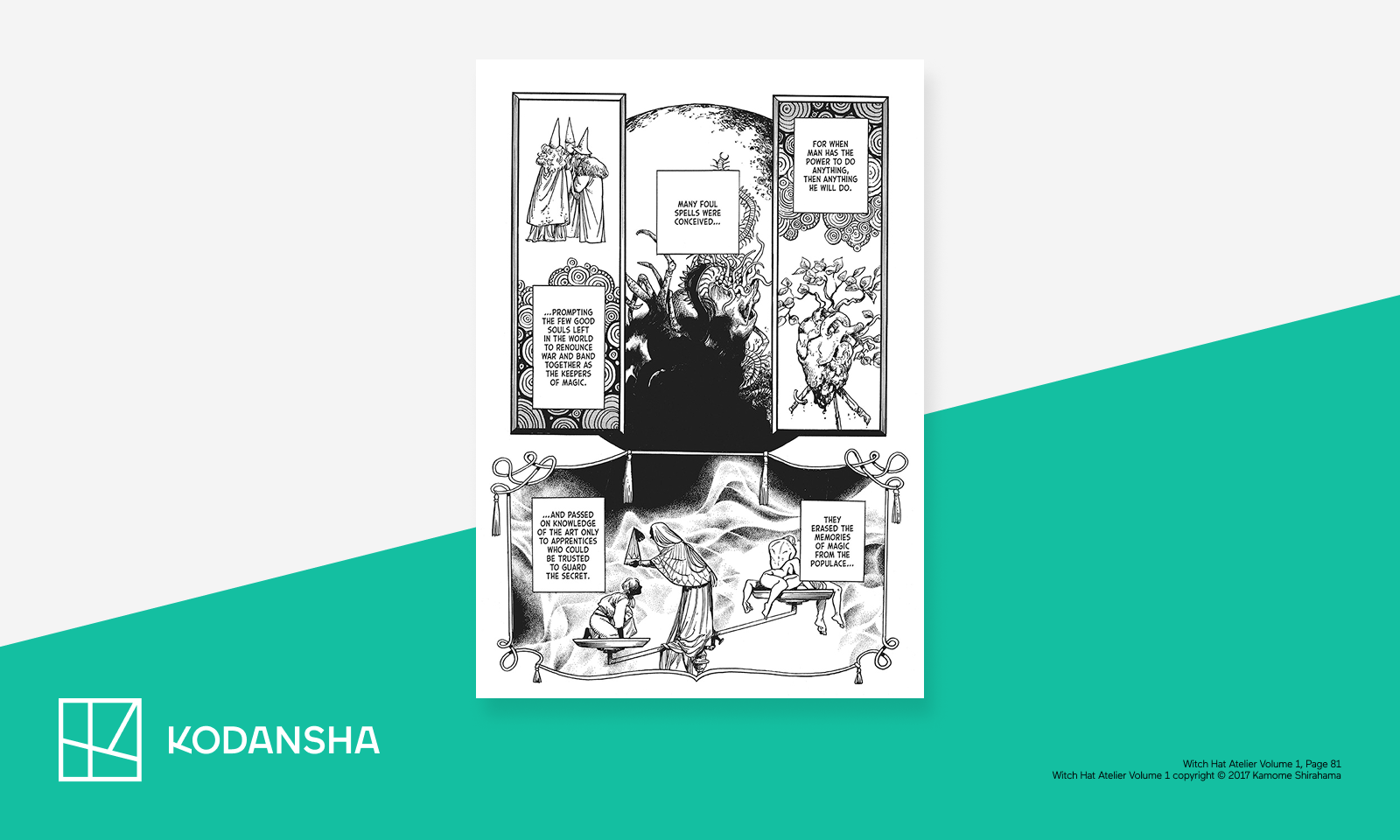
Gatekeeping – In Witch Hat Atelier, magical practices are secrets controlled by a relatively small community of witches. Although anyone can cast spells using the proper tools, this truth is hidden in the name of peace and protection. Witches fear that if the power of magic were given to everyone, it would result in chaos and misery, “for when man has the power to do anything, then anything he will do” (pg. 81). Even as Coco is welcomed into the world of magic, her roommate and fellow apprentice, Agott, sees her as an outsider and challenges her acceptance.
In the real world, it is not uncommon for few to control the access of many. This can be true for media, knowledge, power, etc. The secrecy of magic in Witch Hat Atelier can be a gateway to discussion on gatekeeping in the real world and its ethics, benefits, limitations, and nuances.
Learning and Experimentation – It is common for people to struggle when learning a new skill, often failing or creating sub-par works before finding success. However, failures and shortcomings are often how people learn and grow. Artists, writers, musicians, etc. must push through this phase of experimentation and mistakes before becoming masters of their craft.
Coco’s experiences with the art of witchcraft are no different. When she begins to draw spells, her lines are crooked and uneven, leading to mistakes ranging from the inconsequential to the disastrous. Throughout this process, Coco shows resilience, taking learnings from her failures and applying them to future successes. Ultimately, her early shortcomings are what give her the knowledge she needs to overcome future challenges.
Secrecy and Conspiracy – Witch Hat Atelier Volume 1 gives clues to the layers of secrecy its world contains. Early in the book, it is revealed that the witches keep many secrets—chief of which is the means of casting spells, which could theoretically be learned by anyone with the proper tools and knowledge. As the story progresses, it becomes apparent to the reader that the world’s secrets run far deeper. Various witches allude to tensions that run beneath the surface and foul intentions of unknown forces. Characters speak cryptically leaving the reader to wonder what is going on beneath the surface, and multiple characters seem to have been made aware of Coco, even before she is introduced to them. Although she doesn’t know it yet, Coco seems to be caught in the middle of a plot that remains shrouded in mystery.
Key Characters
Coco is the story’s protagonist. She is a young girl who lives in a small remote town with her mother. Having met a witch at a festival when she was younger, she is now obsessed with magic and wishes she was born a witch. But when she finally sees how magic is cast, she realizes that she does have the tools to cast her own magic! In her ignorance, she accidentally casts a spell that turns her mother and home to stone.
Coco has endless curiosity, and she is fearless—although sometimes out of naivety. Her lack of caution lands her in many precarious situations, but her ingenuity and resourcefulness often help her navigate them. Throughout the book, Coco remains steadfast in her goal to save her mother.
Coco’s Mother runs a textile shop in the small remote village where she and Coco live. Early in the story, Coco’s mother is accidentally turned to stone by a magic spell, driving Coco to leave with Qifrey and discover a way to save her.
Qifrey is a witch that comes to visit the textile shop run by Coco’s mother. He takes great interest in Coco and the picture book of spells that she describes. Unable to shake his curiosity, he returns to Coco just in time to save her from a spell gone wrong.
Qifrey has multiple apprentices that are studying under him to become witches. He is connected to the larger society of witches but chooses not to live with the community. Throughout the book, he hints at covert schemes involving Coco’s mastery of witchcraft and the greater magical world.
The Masked Witch meets Coco at a festival when she is a small child and gives her two items: a picture book of spells and a magic wand. Qifrey is very intrigued by Coco’s description of the masked witch, and the book that she gave to her. After Coco begins to study under Qifrey, the masked witch reappears and stalks Coco throughout the magical town of Kahln.
Qifrey’s Apprentices live with him at his atelier. Besides Coco, he has three other apprentices:
Tetia is very active and excitable. She is the most outgoing and energetic of Qifrey’s apprentices. She is empathetic of others, and she helps Coco settle into her new environment.
Richeh is quiet and mild-mannered. She balances Tetia’s energy and remains calm and measured in most situations.
Agott shares a room with Coco at the atelier. Agott is unhappy with Coco’s unconventional arrival and that she was allowed to become an apprentice without going through the proper processes. She appears cold toward Coco but is still helpful in times of need.
Alaira is a witch acquaintance of Qifrey’s. She lives in a hub for witches near the seaside, called The Great Hall.
Mr. Nolnoa owns The Starry Sword—a stationer’s shop in Kahln. Witches come to him for magical ink, wands, paper, and other supplies. He runs the shop and fashions materials with his son.
Discussion Questions
- What does the word “atelier” mean?
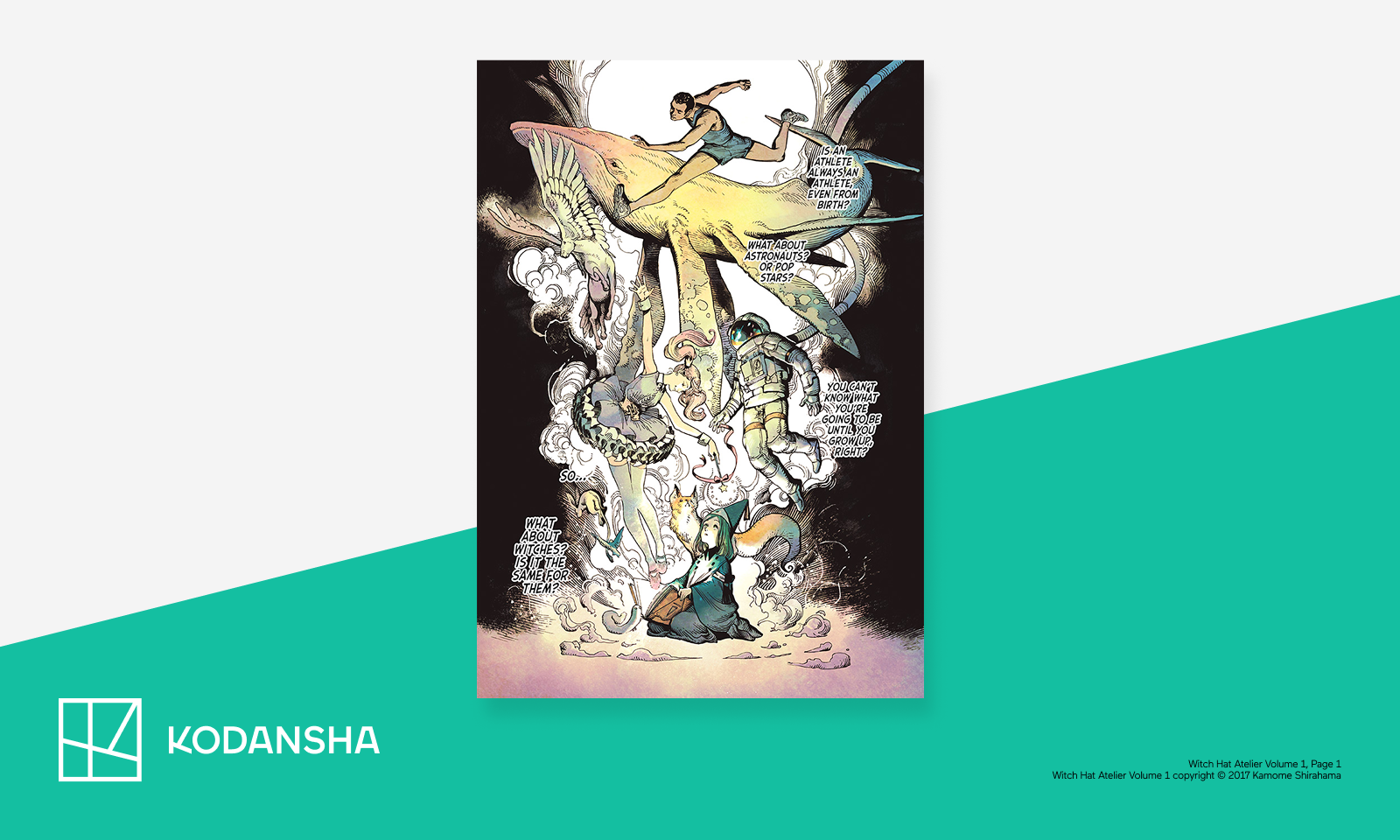
- How does the first page of the story help acclimate the reader to the world of the book? Do you believe that astronauts, pop stars, and athletes are born to be those things, or do they choose those roles as they grow up? How about artists? Why do you think that?
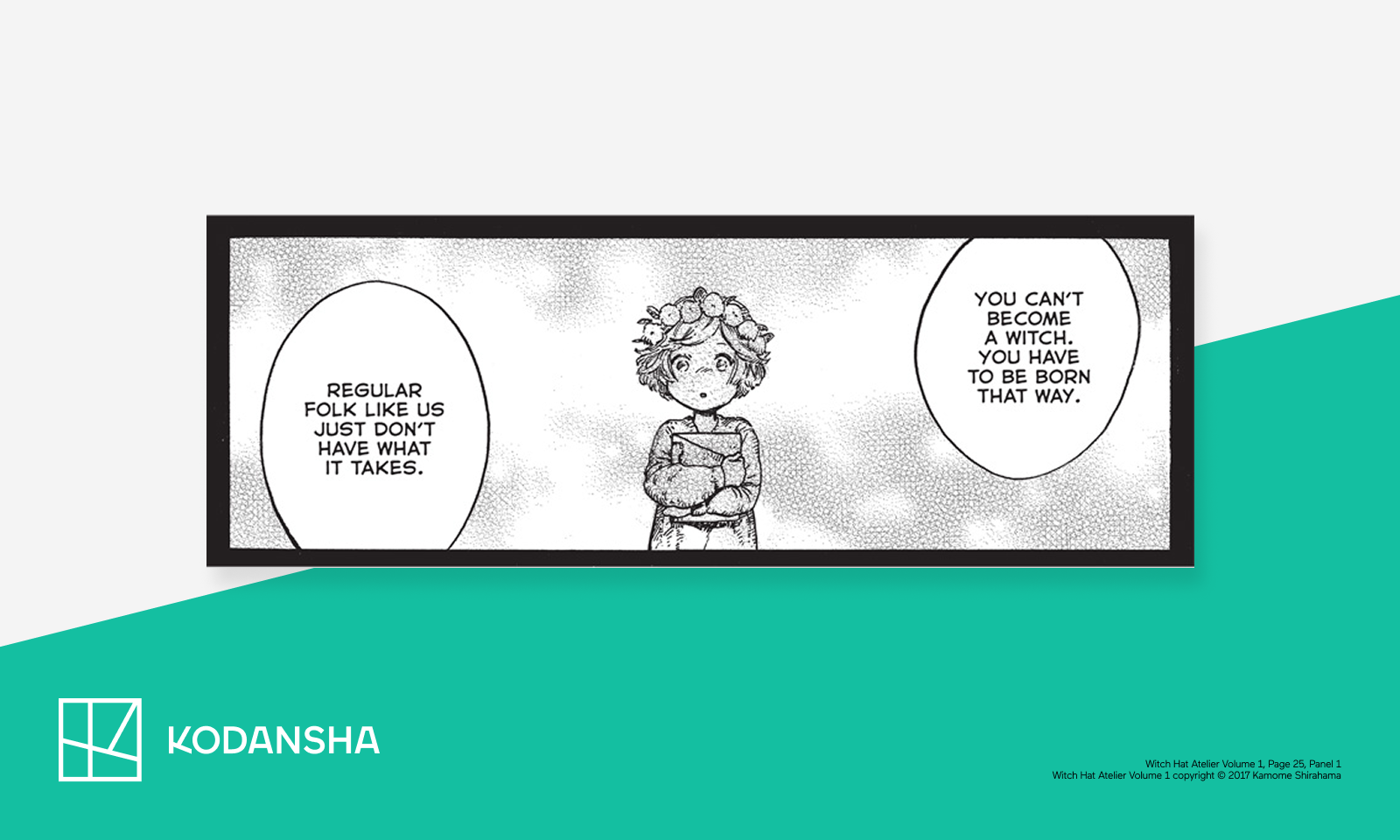
- On page 25, Coco’s mom says, “You can’t become a witch. You have to be born that way. Regular folk like us just don’t have what it takes.” Have you been told something similar about certain professions or aspirations?
- On pages 83 and 84, why do you think Coco is so eager to learn about the forbidden spells?
- Why do you think Agott is cold and antagonistic toward Coco, even before they get to know one another?
- What do you make of Qifrey’s and Alaira’s conversation on pages 125-127? What is being revealed about Coco, Qifrey, and the world of witches? What questions does this raise for the reader?
- Do you think Agott wants Coco to pass the test? Why or why not? Why do you think she lets Coco borrow her shoes?
- On page 181, Coco remarks how skilled Agott is at drawing sigils and says, “I’m sure anyone who draws magic like that must be a lovely person, too.” Richeh replies, “personality and skill aren’t related,” and Tetia says, “Yeah! The best witches are always the weirdest!” Finally, Qifrey responds with, “I’m… not so sure that’s the case.” Is this true in the real world? Are personality and skill related? Are the people that are most skilled at something “always the weirdest”? Why do you think that? Why might skilled people be (or be considered) “weird”?
- Witch Hat Atelier features a few distinct art styles throughout the book. How are these styles different from one another, and how are they used throughout the book? How does the juxtaposition of the different art styles affect the reading experience?
- How does magic in the book serve as a metaphor for art in the real world? Use specific text and images to support your answers.
- By the end of Volume 1, it seems as if Coco has found herself in the middle of one or more schemes involving the masked witch, Qifrey, and the larger witching world. What do you think might be going on? What is special about Coco, and why do you think everyone is so interested in her?
- What comparisons can be drawn to other stories in similar genres? How does Witch Hat Atelier fit within genre conventions, and how does it set itself apart?
Activities
World Building – Like many fictional stories (especially in the sci-fi or fantasy genres), Witch Hat Atelier features a unique world with its own history, cultures, secrets, and more. By the end of Volume 1, readers are offered plenty of details to begin understanding its intricacies, while also being enticed to learn more. In this activity, readers can practice building their own new fictional worlds using Witch Hat Atelier as a model.
First, encourage readers to analyze what they know about the world of Witch Hat Atelier. This can be done using a mind map to visually organize ideas into categories such as “magic,” “society,” “geography,” “history,” etc. These categories can then be split into subcategories. For example: “society” can have sub-categories such as “clothing,” “factions,” “culture,” etc. The category of “magic” can have sub-categories such as “rules,” “types,” “tools,” etc. Then, readers can write details they have learned about each sub-category to summarize the world of the book.
Once readers have created a mind map describing the world of Witch Hat Atelier, they can use it as a model to brainstorm details of a new world. Readers can use similar categories and sub-categories for their new world, then think of new details that could fit within each category. If desired, after creating a mind map about their world, they can also design characters, objects, or environments that might fit within that world. Encourage readers to use their new mind maps as a starting point for a new story, comic, game, etc.
Art Analysis – The art of Witch Hat Atelier is one of its most compelling components. Within it, Kamome Shirahama draws on various artistic styles and movements throughout history as well as techniques specific to manga, all while adding her own personal touch. In this activity, readers will learn more about classical art styles and manga, and they will identify possible inspirations for Witch Hat Atelier.
First, instruct readers to research various classical art styles and movements. If you are working with a group, each reader can choose one style to focus on. Styles may include Romanticism, Renaissance, Art Nouveau, Art Deco, Baroque, Magic Realism, etc. For each style, readers should identify a few common elements of works in the style, and they should identify 2-3 representative works. Finally, readers can come together and present their findings to one another. Discussion can be had as to whether the chosen art styles may have inspired the art of Witch Hat Atelier, referencing specific panels and pages as needed. If desired, readers can also research other art and illustrations from classic fantasy stories and draw comparisons to the researched art styles and the art within the book.
Similarly, readers can reference other manga series to identify artistic tropes common to manga that are utilized in Witch Hat Atelier. While these may be less defined by specific names and definitions, readers should have no trouble finding similarities, especially in the way humor is used and drawn within the book.
The Hero’s Journey – Although Volume 1 represents a small part of Witch Hat Atelier’s story, readers may recognize many elements of Coco’s adventures so far. Already, Coco has fulfilled many parts of Joseph Campbell’s template of The Hero’s Journey. In this activity, readers will learn more about The Hero’s Journey, and they will identify where Coco has and has not followed the template of the monomyth.
First, readers should be exposed to the idea of The Hero’s Journey. This can be done using videos on YouTube, or by using visual aids while talking through various examples as a group. Once readers have demonstrated their understanding of The Hero’s Journey using examples of popular stories that follow the template, readers examine the events of Witch Hat Atelier Volume 1 and discuss how the story does and does not follow the established template. Finally, using the template as a guide, readers can guess what might happen moving forward in the series. If readers are familiar with other manga series, it may be noted that many feature multiple story arcs. In these examples, The Hero’s Journey may be more cyclical than in other, shorter stories.
Pairing Suggestions
- Witch Hat Atelier Kitchen by Kamome Shirahama and Hiromi Sato. Kodansha. (Manga Series)
- Witch Hat Atelier (Anime series)
- RWBY by Rooster Teeth Productions. VIZ Media (Manga Series)
- My Hero Academia by Kohei Horikoshi. VIZ Media (Manga Series)
- Demon Slayer: Kimetsu no Yaiba by Koyoharu Gotouge. VIZ Media (Manga Series)
- Naruto by Masashi Kishimoto. VIZ Media (Manga Series)
- Hikaru in the Light by Mai Matsuda. Scholastic (Manga Series)
- A Wizard of Earthsea by Ursula K. Le Guin. (Novel). Graphic Novel Adaptation by Fred Fordham. Clarion Books.
- Black Panther by Various. Marvel Comics (Graphic Novel Series).
Witch Hat Atelier volume 1 copyright ©2017 Kamome Shirahama
Witch Hat Atelier volume 1 English Edition copyright ©2019 Kamome Shirahama
Witch Hat Atelier Volume 1 Reading Guide copyright ©2025 Kodansha
All Rights Reserved