WIN THIS AUTOGRAPH!
But that's not all. You can actually win the autographed sketch Koyama-sensei draws in this video. All you have to do is take this quick survey.
For more feature on Chuya Koyama and Space Brothers, check out KodanshaComics.com
When the movie was released in Japan, Chuya Koyama, the creator of Space Brothers, drew his own take of The Martian movie poster. It was displayed in theaters throughout Japan as a special collaboration.
And behold! Here’s the finished product of Koyama’s Space Brothers-version The Martian movie poster side-by-side the original The Martian poster. “Mutta Damon” looks slightly more good-looking than usual!
Here’s Chuya Koyama on The Martian:
The Martian was a really amazing movie. I can honestly say so because it’s true. The equipment in space, the harsh environment of Mars, how you can survive there … all these details based on science seemed very realistic and made me feel like I was there too. The plot and the casting also made every scene very worthwhile. I was so excited throughout the movie and stunned by the end.
I don’t want to give away any spoilers for the sake of people who haven’t seen this movie yet, but it’s certainly a movie I want to talk about with people who have seen it. The next time anyone asks me,“What’s your favorite movie?” I’d like to answer,“The Martian.”
I also had a lot of fun working on the Space Brothers version of The Martian poster. I was looking at the face of Matt Damon when I was drawing this illustration, so Mutta is as good-looking as ever! [laughs] Thanks, Mr. Matt Damon. I am looking forward to seeing both of these posters in theaters.
––Chuya Koyama
About Chuya Koyama
Born in Kyoto, Japan in 1978. Debut short story, GGG, won Seizou Watase Award for 14th Annual Manga Open. Following year, his next piece Gekidan Jets won the Grand Prize for the same award. In 2006, he started his first manga series about ski jumping, Harujan, in Morning magazine. Then he also turned his debut piece, GGG, into a series in the same magazine. In 2007 he started his first weekly series, Space Brothers, which was adapted into an anime series and live-action movie in 2012.
Once you get to know some mangaka (manga artists), it seems every one bears some resemblance to their own manga. Same for Chuya Koyama, the creator of Space Brothers. Not that he has a big afro or a spiky hair like his main characters, but they all share a familiar human power—a determination to penetrate the unknown.
“Some parts of myself started to integrate with each character.” ––Chuya Koyama
About Chuya Koyama
Born in Kyoto, Japan in 1978. Debut short story, GGG, won Seizou Watase Award for 14th Annual Manga Open. Following year, his next piece Gekidan Jets won the Grand Prize for the same award. In 2006, he started his first manga series about ski jumping, Harujan, in Morning magazine. Then he also turned his debut piece, GGG, into a series in the same magazine. In 2007 he started his first weekly series, Space Brothers, which was adapted into an anime series and live-action movie in 2012.
Space Brothers is about the two brothers who wanted to become astronauts. Hibito, the younger brother (left), followed his dream and became an astronaut first, while Mutta, the older brother (right), needs to catch up. Can they go into space together one day?
Kodansha Comics (KC): What were you like when you were a kid? Chuya Koyama (CK): I don’t remember too much. [laughs] I was living on the first floor of an apartment complex. There was a fenced balcony, and I used hang out there in the sun.
KC: Did you grow up with any siblings? CK: I was the only child.
KC: If you’re an only child, how can you draw the brothers in Space Brothers? CK: For that, I had to ask my friends who have siblings what it’s like to have a brother or sister. I also asked my editors about it too. The rest is sort of my imagination. I think every relationship between siblings is different, so I wanted to make sure the relationships between characters in my story are convincing.
KC: Did you have any models for the two main characters of Space Brothers, Mutta and Hibito? Or was it completely based on your imagination? CK: When I first thought of the character Mutta, I was reading a book called Kimi ni Tsuite Ikou (I Will Follow You: My Wife Wants to Go to Space) by Makio Mukai. It’s written from Mukai-san’s point of view, but he had an interesting point of view. He has very good eyes for observation, and with that, he remembers and analyzes the impressions people make. I thought that was an interesting personality, so I wanted to make the main character of my story someone like him. Also in Mukai-san’s writing, he uses the word “watashi” (formal first-person pronoun) when he refers to himself. But in everyday talk, he uses more casual pronouns, like “ore” or “orecchi.” That’s where Mutta got his habit of referring to himself as “watashi,” to be sort of formal in the monologues of Space Brothers. That sort of became the basis of the character. But as the story progresses, some parts of myself started to integrate with each character. That goes for Hibito as well as Mutta.
Koyama worked on the cover art of Makio Mukai’s book that inspired him to work on Space Brothers. Actually there is another character in the series that kind of resembles him.
KC: Mutta or Hibito, which one’s personality feels closer to yours? CK: I think I’m more like Mutta. But I think there’s a part of me like Hibito too. I’m often contemplating like Mutta, but sometimes I am determined like Hibito.
Although they are brothers, Mutta and Hibito have completely different personalities. While Hibito sees the positive in things, Mutta tends to see the negative.
KC: Why did you become a mangaka? CK: At first, I wasn’t sure if I could become a mangaka [laughs]. But if I could, I wanted to become one. So just testing my ability, I wrote some manga and went to show it to editors. Out of them, an editor from Kodansha found my work interesting. So we’ve started to work together, and I came up with GGG, which won an award.
KC: Why did you decide to make a manga about outer space? CK: I was talking to an editor to figure out the next story idea, and he suggested,“What about a story about outer space?” At first, I wasn’t sure if I could do it, because I wasn’t very knowledgeable about space. Also there are hit manga about space, like Planetes and Moonlight Mile, that already exist. I knew that it’d be compared to those manga, and it’f be hard to outdo them. But honestly, I didn’t contemplate for too long [laughs]. Also Chuya Koyama is my real name, and my first name contains the word “Chu” [note: 宙 means “space”]. I thought it’d be a funny joke if Chuya Koyama worked on a story about space. Maybe it was destined.
KC: How did you get into this subject of space when you weren’t so familiar with it? CK: Like I said, my first introduction to space was Kimi ni Tsuite Ikou (I Will Follow You) by Makio Mukai. I also went to get some insights from people who are knowledgeable about space and science. At first, there’s a story idea. Based on that, I contact and ask a specialist about the details that I want to know. So let’s say there’s an exam to become an astronaut. First, I research about that exam as much as I can, then go talk to someone who was actually familiar with the exam. Almost every time, I come up with a scene in the story, then later ask them to check the facts in the manga. Sometimes I go visit JAXA, sometimes I go watch the rocket launch.
Mutta watching Hibito’s rocket launch. This scene was set in Houston, Texas, where Johnson Space Center is located.
KC: There are scenes in Space Brothers that take place in different countries. Do you often go to those places and talk to people for research? CK: I’ve been to America a few times to go see NASA. But I wish I could go to different places more often and talk to the people there. I’m from Japan, so the scenes set in Japan are still the easiest ones for me to draw. Regarding places I’ve never been to, I ask someone who is more familiar with the region.
KC: When a specialist looks at your work, what kind of feedback do you get? CK: The reality and manga are different. Manga is entertainment, so it has to be entertaining. The specialists knows about the reality more. But the reality could be kind of boring. The reality could be just about the budget of the space program. I think a little bit about that too, but if I am concerned about just the reality, I won’t be able to make a manga. The people who check facts for me also understand this, so they let certain things slide, because it’s manga. Sometimes they point out what could be possible in reality, which makes me happy.
KC: When you make a story, is there something that you keep in mind? CK: The balance between reality and fiction is the key. It would’ve been a totally different manga if it was even more science fiction, with aliens in it. But I started this series in a sort of realistic setting. So I want to think of something based in reality, like what kind of people would become an astronaut, why, and how.
KC: All the characters in Space Brothers have unique personalities. Do you have any models for them? CK: Sometimes there’s a person that I loosely base the characters off of, but the rest are my own creation. For example, Mutta and Hibito’s mom is loosely based on my mother in law. She always says funny things, like calling a “cheese fondue” a “cheese fonduo.” [laughs] I thought that was kind of funny, so I included things like that in the character’s personality too.
KC: What’s the most difficult thing about working on Space Brothers? CK: Working on a scene in space is the most difficult for me. I’ve never been to space, and there’s limited information about it too. So it’s hard to imagine what it’s like to be in space. In contrast, it’s easier to work on a scene on Earth, because we’re here. It’s much easier to draw about the environment that you are familiar with, like your hometown. But when I have to draw a scene on the moon, I have to rely on my imagination. Even if I asked a question to a specialist, I wouldn’t be able to get a definite answer. For example, whenever I ask a specialist,“What would happen if you bring an apple or watermelon into space?” Everyone’s answer is different. A physicist could use his knowledge and imagination to tell me what could theoretically happen. It’s not like anyone has actually done such a thing in space. So it starts to be matter of opinion. At that point, I have to make my own decision to make my story seem real.
An amazing scene on the moon was drawn based on research and imagination.
KC: Do you have any assistants currently? CK: Yes, I have 5 assistants. It’s quite a lively workplace, because everyone loves to chat. Sometimes I put on a movie or an anime to quiet them down [laughs]. Even when you’re doing focused work like drawing manga, your ears still hear sounds. Some people get distracted when there’s a conversation going on. It takes a different kind of brain to have a conversation and draw manga at the same time. It’s kind of difficult to do both.
KC: Speaking of, what does it feel like to see your work adapted into anime or a live-action movie? CK: There are pros and cons to everything. But it’s not like one is better than the other. An anime is made with drawings, so there’s a certain quality of art that I want the production team to follow. A live-action movie is kind of up to the actors, but there are other elements that’s not in manga, like the sound effects and music. You can make a certain scene, like the rocket launching scene, to look, sound, and feel much more intense than manga.
KC: What’s your sign? CK: I’m a Libra.
KC: Do you have any hobbies? CK: I like listening to music. When I just started to work on Space Brothers, I was listening to Sigur Ros and got really inspired. Later on, the song was actually used for the Space Brothers live-action movie. That made me really happy.
“Hoppípolla” by Sigur Rós was in the soundtrack of the Space Brothers live-action movie.
KC: Do you have any audience in mind when you write manga? CK: Not really. I just want as many and different kinds of people to read my manga as possible. Anyone who likes manga could read it. Or better yet, I want someone who doesn’t usually read manga to read it. There are some people who has negative ideas about manga. But I personally learned a lot from manga. It’s something that makes your life rich. Like putting yourself in the shoes of a character, and think of how to move forward in life, or to think which character’s personality resonate with you most. Just thinking about these things are worthwhile to me.
KC: What does it feel like to know that there are people outside of Japan reading Space Brothers? CK: A part of me wish everyone could read Space Brothers in Japanese. There are many plays on words in the story that I imagine are really hard to translate into another language. That silliness combined with serious scenes make this story whole. For example, there’s a chapter when Mutta learns the English saying “It’s a piece of cake.” But I wonder if that scene is meaningful for native English speakers, because the phrase is already in English.
What does this phrase mean to Mutta? You’ll find out as you follow the story.
KC: Even if all those jokes may not directly translate into English, you can still get the sense that the characters in Space Brothers seem multidimensional and whole, very much like real people. CK: That makes me happy to hear. I didn’t expect that. Those characters in Space Brothers came from me, who is very Japanese, and very introverted. [laughs] So I was concerned that some nuances and way of thinking may not be understood by people from Western culture. But if someone from another country could still understand and sympathize with any of my characters, that makes me really happy. I do appreciate the fact that in there are different kinds of people in this world, with different backgrounds, upbringing, and ways of thinking. Maybe if I lived in an English-speaking country some day, the characters I draw may start to change too.
KC: Do you feel like you’re an introverted person? CK: I think so. [laughs] I think most people who draw manga are introverts. They’re often not really good with words and communication, so they want to do it through manga. But artists are better at speaking than drawing though.
KC: Would you want to go to space one day? Where do you want to go?
CK: Of course I do. If I could go anywhere in space, like even using a time warp, I want to go to a distant planet where there’s oxygen to breathe, and living creatures could live. I hope I can encounter strange living creatures that evolved in completely unexpected ways on that planet. But then again, there are strange creatures on this planet too. So maybe the experience wouldn’t be much different.
KC: Would you still go to space if you only have a one-way ticket? CK: Maybe if I was over 60, I might go. But it might depend on who I go with. I definitely don’t want to go by myself. Actually I am not so sure now if I want to go if it was just a one-way ticket.
KC: If someone had never read Space Brothers before, what would you tell him or her? CK: Some people may think it’s a complicated story because it’s about space. But it’s not true. It’s a simple read, because the creator (me) who doesn’t know much about space either, was trying to learn, digest the information, and make it easier to understand it for anyone. If you are shying away from Space Brothers because it’s about the space, think again. It might become your gateway to find a new interest about this subject matter.
KC: Thank you!
Space Brothers volumes 1 through 19 are available from Kodansha Comics.
Also the latest chapter of Space Brothers is available on Crunchyroll Manga.
If you've been waiting for Oh!great's inline-skating epic Air Gear to make its way to digital, have we got the news for you: the Air Gear digital bomb has dropped—
—with all 6 omnibus editions (covering volumes 1 through 17 of the original single-volume releases) and
About Hiroya Oku
Born in Fukuoka, Japan. Debuted as a mangaka (manga artist) in 1992, with his first series, Hen: Suzuki-kun and Sato-kun in Weekly Young Jump. The series became a hit and was adapted into a live-action TV series in 1996. In 2000 he started his most famous work, GANTZ, a sensational manga using CG for the background, driven by thrilling plots. It was adapted into anime, game, and live-action film and became a widely popular media franchise. In 2014 Oku started his latest series, Inuyashiki, in Evening.
As many a mangaphile already knows, Kodansha Comics publishes some of the best shojo comics around. Say I Love You. by Kanae Hazuki has been a recent breakout hit, but LDK by Ayu Watanabe, now just on its third volume, has gotten off to a great start. And Fairy Tail fans should definitely check out the fun new shojo spinoff, Fairy Tail Blue Mistral by Hiro Mashima and Rui Watanabe.
Devil Survivor, the manga by Satoru Matsuba based on Atlus' video game, has been making waves, and now we have another Atlus game tie-in debuting this week, with Volume 1 of Persona Q: Shadow of the Labyrinth Side: P3 by mangaka So Tobita. Check out the free preview of all of Chapter 1 here.
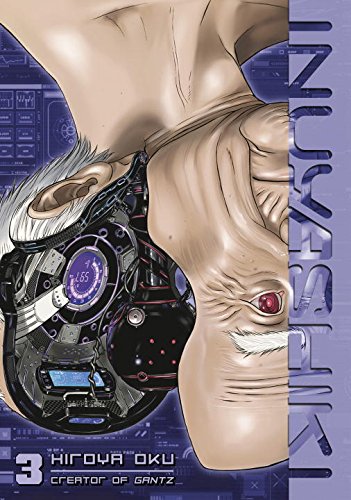
Meanwhile, on a somewhat different wavelength, what's more fun than a new volume of Inuyashiki by Hiroya Oku—maybe the most shocking new manga launched since (Oku's own) Gantz? Check out our mind-bending interview with the very-intense and iconoclastic mangaka, coming soon!
Finally, major new strides in digital: new volumes of astronaut-drama Space Brothersand post-apocalyptic actioner COPPELION arrive on digital shelves this week.
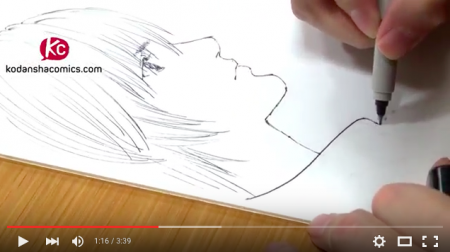
Have you seen the video of Hiroya Oku drawing the characters from Inuyashiki on Kodansha Comics’ YouTube series,”These Hands Make Manga”? Well, guess what? We’re giving away this very sketch––with Oku-sensei’s autograph! He’ll even personalize it, signing it with your name! All you have to do is take this quick survey*. *Sweepstakes ends on March 11, 2016. For more features on Hiroya Oku, the creator of Inuyashiki and GANTZ, click here.
Do you ever wonder where a great artist get his or her influences from? Hiroya Oku admits to his passion and admiration for Hollywood movies and other popular media, which partly explains his cinematic storytelling in manga like Inuyashiki and GANTZ. But how deep down the rabbit hole does he go for truly original expression that hasn’t ever been done by Hollywood? It’s way deeper than anyone could ever imagine.
This is Part 2 of the interview with Hiroya Oku (on Hollywood movies). Click here for Part 1 (about Inuyashiki).
About Hiroya Oku
Born in Fukuoka, Japan. Debuted as a mangaka (manga artist) in 1992, with his first series, Hen: Suzuki-kun and Sato-kun in Weekly Young Jump. The series became a hit and was adapted into a live-action TV series in 1996. In 2000 he started his most famous work, GANTZ, a sensational manga using CG for the background, driven by thrilling plots. It was adapted into anime, game, and live-action film and became a widely popular media franchise. In 2014 Oku started his latest series, Inuyashiki, in Evening.
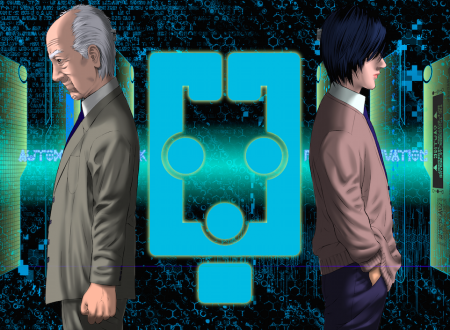
Inuyashiki is about a conflict between two ordinary people whose bodies are one day replaced by super robots. One decides to use the new body for good, another for evil.
“My goal is to make something that hasn’t been done by anybody yet.” —Hiroya Oku
Kodansha Comics (KC): Do you have any hobbies? Hiroya Oku (HO): I love collecting figurines and watching movies. I constantly watch movies. Sometimes I go watch a movie in a theater, and on the way home, I rent another movie. I think I watch at least one movie a day. [laughs]
A figurine of Reika from GANTZ on Oku’s desk.
KC: What kind of movies do you like to watch? HO: Generally I like action or science fiction, but I also watch romance or drama, or any movies from America, France, Iran, or anywhere if it seems interesting.
KC: Did you watch any good movies recently? HO: I liked Kingsman: The Secret Service.
KC: Do you think watching movies helps your storytelling in any way? HO: I want to stay on top of anything new from Hollywood and video games. I use the internet to keep up on the most cutting-edge expression out there. On top of that I want to take my own expression slightly further than what’s already there. My goal is to make something that hasn’t been done by anybody yet. If anyone says something like,“Oh, that’s just like Halo,” it means that it’s not really interesting, because it’s not truly original. If anyone says,“I’ve never seen anything like this before,” that’s what you’re looking for. Whether it’s manga, movies, or anime, people won’t be interested in your work if you don’t do something that anyone hasn’t seen before.
Hiroya Oku’s audio room. He has a projector screen, too.
KC: Is it hard to making a new expression when you have nothing to compare? HO: I guess it is, and it isn’t. I’m observing what’s been done and what’s not been done in films and video games. Based on that, I simply ask myself,“Has this ever been done before?” The gauge is there, so I don’t have too much trouble making new expressions.
KC: IfInuyashikiwas a movie, which genre would it be categorized under? HO: I think it’d just be under science fiction or superheroes. I’ve always loved the superhero genre since I was little, like Kamen Rider and Ultraman. I don’t really watch those shows nowadays, but I still watch all the movie adaptations of American superhero comics, like Spiderman.
KC: What’s your opinion of movie adaptations of comic books? HO: I think they often do a really good job turning a comic into a movie. Honestly, I’m not that interested in the American comics themselves. But when they become a movie, suddenly it becomes easier to get into. You can tell that very talented people work hard to brush up the original work, like the designs, to make it look cool in a modern-day live-action movie.
KC: Do you get inspired from looking at other people’s work, like these movies? HO: Absolutely. That’s basically everything to me. I kind of look at them [Hollywood creators] as my rivals. It motivates me to go above and beyond what they’re creating. I even dig into the artbooks and reference books that detail the process work of all these movies, and compare it to the final works in the actual film. It’s fascinating to see different parts of movie production assigned to genius-level talents. It’s definitely hard to outdo them with my own small team. Yet we still have to try, because it’s pointless to just “copy” Spiderman and Avengers. Trying is the only way to surpass what’s already been done. That’s what’s in back of my mind when I am making manga.
This is just a fraction of Oku’s personal collection of movies.
KC: What is your sign? HO: I'm a Virgo.
KC: Do you want to go work in Hollywood one day? HO: No. Actually I don’t really like traveling abroad because I am terrified of flying on a plane. [laughs] So I don’t want to go overseas too much.
KC: What if your manga becomes a Hollywood film, how would you feel then? HO: If that ever happens, I’d probably be very happy. And I am hoping that would happen someday. But that’s more like a dream and also has to do with luck. So I’m not counting on it too much.
KC: Do you realize that there are fans of your work in other countries too? HO: If my manga resonates with someone overseas, it just means that person shares my taste. That itself wouldn’t be so surprising. Because it’s just like how Hollywood movies are appreciated by different people around the world. I get influenced from the movies or videogames that I like and make something more than what already exists. If some people get it or like it, it’ll makes me happy, but it wouldn’t be so surprising.
KC: Do you have any comments for your fans? HO: To know that there’s somebody from a completely different part of the world who likes to read my manga, that makes me really happy. I’m trying to make Inuyashiki as if it’s a single movie, and it will get more exciting as the series progresses. So I hope you look forward to it and follow Inuyashiki.
Hiroya Oku is an alchemist of storytelling. He closely studies theories behind storytelling in every popular media, imbibes them, and somehow transforms them into a truly original story that no one has ever seen before.
If you’ve been away from manga, thinking you’ve seen it all, think again after reading Inuyashiki, the newest mind-bender of manga by the creator of GANTZ.
This is Part 1 of the interview with Hiroya Oku (about Inuyashiki). Click here for Part 2 (on Hollywood movies).
About Hiroya Oku
Born in Fukuoka, Japan. Debuted as a mangaka (manga artist) in 1992, with his first series, Hen: Suzuki-kun and Sato-kun in Weekly Young Jump. The series became a hit and was adapted into a live-action TV series in 1996. In 2000 he started his most famous work, GANTZ, a sensational manga using CG for the background, driven by thrilling plots. It was adapted into anime, game, and live-action film and became a widely popular media franchise. In 2014 Oku started his latest series, Inuyashiki, in Evening.
“I try to make a story that I want to see next.” ––Hiroya Oku
Kodansha Comics (KC): What was it like when you were a kid? Hiroya Oku (HO): When I was a kid, I liked playing outside. I used to play baseball with other kids, roller skated, made hideouts. I was just an ordinary kid.
KC: When did you pick up drawing? HO: I got into drawing when I was in kindergarten. I remember being influenced by another kid who was drawing on the sand on the ground using a rock. I was drawing superhero characters from tokusatsu (special effects) TV shows. It was just simple drawings with basic shapes, so it was easier than drawing other things like humans.
KC: Did you read manga back then? HO: Not really. I used to watch TV more, so I saw more anime, like Kyojin no Hoshi and Tezuka’s Jungle Taitei (Kimba the White Lion). I remember being really into it.
KC: Do you still watch anime? HO: Not really. I rarely watch anime nowadays.
KC: What were you doing between your previous series, GANTZ, and your current series, Inuyashiki? HO: Actually there was hardly any time between those series. I thought of the idea of Inuyashiki when I was wrapping up GANTZ. So Inuyashiki was already set in motion before I was done with GANTZ. When GANTZ ended, Inuyashiki started immediately, so I didn’t have any break in between.
KC: How did you think of the idea of Inuyashiki? HO: When I was still working on GANTZ, the editor from Kodansha came and asked me if I wanted to do my next manga series for their magazine. So I was thinking about what what kind of story I wanted to work on next. Around that time, I was randomly watching the new Astro Boy movie. The setup of the story is that once there was a human boy, the original, who died, and thus they made a copy of him as a robot, which is the Astro Boy. I thought this was interesting. If I could make my own version of the story, with a similar setup, it could be a new series. That was the beginning of Inuyashiki. It’s about an ordinary person who dies and gets replaced by a super robot. When I was working on GANTZ on Shueisha’s Young Jump Magazine, I was more concerned about the popularity and sales figures of my manga. In that magazine’s culture, there’s an unspoken rule to make the main characters visually attractive. When I started work for Kodansha’s Evening, there was more freedom. So I suggested going with the not-so-good-looking teenager as a main character. They green-lit the idea, so I started drawing the character in the manga. But something wasn’t working right. So for a try, I drew an old man as the main character instead. Then everything clicked.
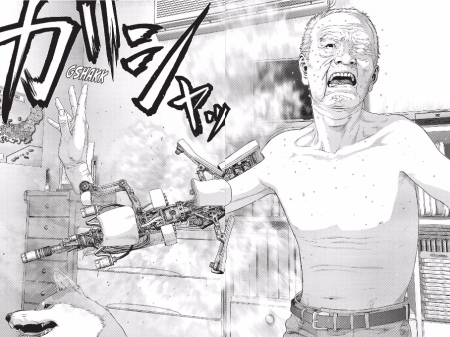
KC: How would you describe the two main characters in Inuyashiki? HO: They both start out as human, but as they become robots, they start to feel the void in life. It would be hard to admit if your body suddenly became a machine. I would imagine that they’d feel like they’re not truly alive. In order to fill the void, one starts to save lives with his new body, and another starts to take lives. One becomes good, and one becomes evil. Ultimately, they have to face off against each other.
KC: So these main characters have a body of a robot, but also a heart of a human? HO: They’ve definitely got hearts of humans, because they were originally copied from humans. But when they realize they are not really human, they become really sad, very empty, and have a hard time accepting this truth. So they want proof that they’re alive, thus they take their own course of action.
KC: It’s kind of a sad story. HO: It is kind of a sad story. Astro Boy was like that too. Like in the world of Astro Boy, the robots don’t have the same rights as humans. This becomes a conflict when a robot has a personality of a human. This is one of the ongoing themes for all science fiction, so I wanted to spin it in my own way.
If you suddenly became a robot one day, what would you do?
KC: Do you like making stories or drawing art? HO: I like them both. I like the process of taking all aspects and turning it into a manga. I like writing stories, drawing art, and confirming what it turned out to be. When I make a manga, I start out with a blueprint in my mind. It consists of logic and theories, but I try to combine these loose ideas and components into a single piece. Only when I look at it later, I can clearly see what it turned into. Sometimes it turns out to be better or worse than what I expected. That’s really interesting to me. It’s like a science experiment. You have a theory, like, if you combined chemical A and B, it’ll make an explosion. Sometimes it goes accordingly to your theory, sometimes it becomes a bigger explosion than you expected. [laughs]
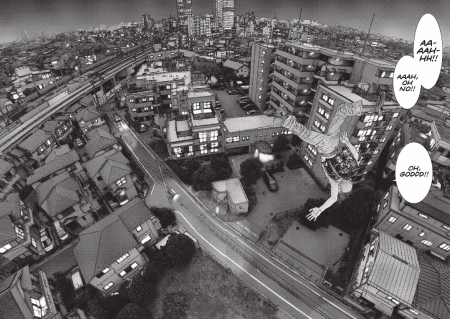
KC: Do you have an example of one of your manga experiments “getting out of hand” in Inuyashiki? HO: In my manga, we use photos and CG as backgrounds. So in general, it’s hard to tell how the scene is going to look and feel like until it’s done. For example, for the scene in Inuyashiki where the characters fly in the sky, we used a drone. Actually, we hired someone to fly a drone to capture a birds-eye view and used that image as the manga background. We also hired a helicopter to get a higher view. But for the moment of take-off, I had a feeling that we wouldn’t be able to capture it without a drone. I had no idea what it was going to look like. It turned out to be a scene with more presence than I ever imagined. I don’t think anyone has ever used that method in manga—or maybe it’s even rare in live-action films—so I was quite happy. It really feels like flying.
A flying scene from Inuyashiki volume 2.
KC: How much of your work is made with digital vs. traditional media? HO: Everything except human or animal characters are done in digital. Most of the background, mechas are digital, but anything that is alive is all drawn by hand.
KC: When you make a manga, do you have a certain audience in mind? HO: Not really. I try to make a story that I want to see next. I tend to imagine if there was another person like me, an audience who enjoys all things entertainment, like movies. I try to make manga that may be interesting to that person. Otherwise, it’s never-ending. Everyone thinks differently, and you can’t please everyone. So I tend to focus on what’s interesting to me. Someone who has similar taste as mine may enjoy my manga.
Have you ever wondered what the creator of your favorite manga is like in person? You won't be disappointed with the way Mashima-sensei is after reading this exclusive interview. Read more …